
Alpha & Omega
Written by Goro, August 30, 2019
Something came down from the sky on September 8, 2004. It crashed into the desert floor of the Dugway Proving Ground in Tooele County, Utah like a meteor. But it wasn’t a meteor…

It was a message…


…with a sample of solar wind particles…

…it had collected while visiting the Sun in “search of origins”.

This was NASA’s “Genesis” mission.

A failed parachute meant the helicopter could not catch Genesis midair as it was supposed to, sending the spacecraft straight into the ground at full speed. (Watch Genesis crash video #1, video #2.)

An unfortunate mishap, or was this the secret plan all along? Was this a simulation of a “solar deep impact”? Or a much more profound ritual?

It did become openly ritualistic when the Genesis team went back to the site 2 years later (2006), ceremonially erecting a metallic obelisk complete with a time capsule placed inside.


How ancient Egyptian of them…

…and how evocative of the Trinity monument at ground zero where the world’s first nuclear bomb was detonated in the neighboring state of New Mexico on July 16, 1945…
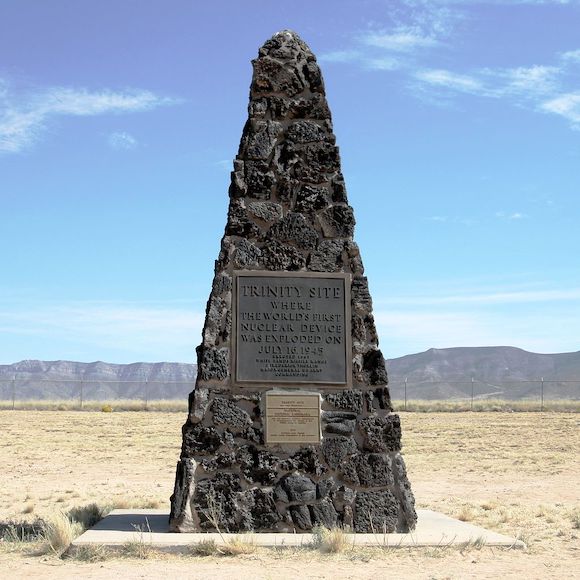
…the same date (Julian) thousands of years ago marked by the heliacal rising of Sirius around the early phase of the ancient Egypt civilization (Old Kingdom) where people called the star spdt meaning “triangle” echoing the obelisk shape and the name “Trinity”.
In ancient Egypt the heliacal rising of Sirius (New Year’s Day), the calendar, and the annual flooding of the Nile all seemed to blend together to form a perpetual cycle of life in perfect harmony with the essence of time. For all intents and purposes Sirius was the “Star of Egypt”, a celestial anchor, around which the whole ancient Egyptian civilization kept revolving.

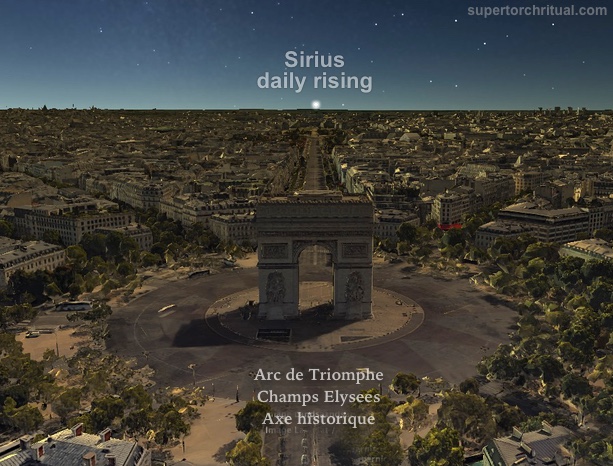
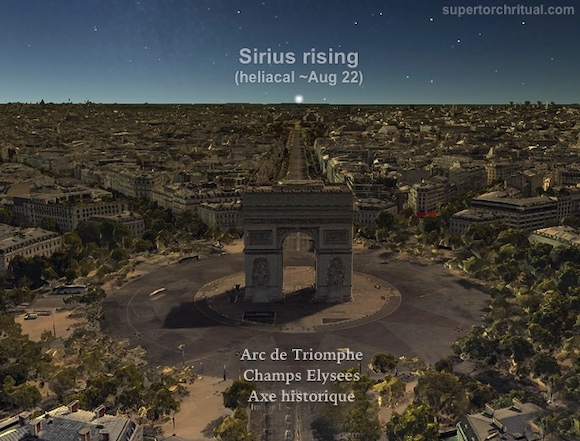
Sirius is also the star of Paris with its main axis (Axe historique/Champs Elysees) aligning each day with the star’s rising – a daily occurrence very few people are even aware of, but such is the nature of this type of “magic”.
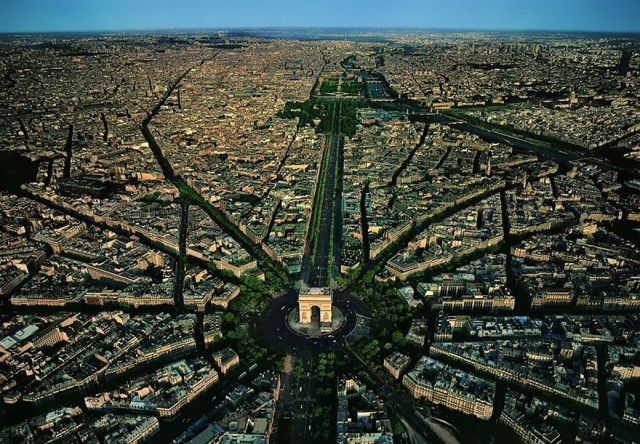
Paris has a secondary axis – where the Eiffel Tower stands – called the Champ de Mars…

…which if extended westward across the Atlantic Ocean into the United States…

…pinpoints the Genesis crash site. An alignment now quietly acknowledged by the Egyptian/Sirian monument.
+ – + – + – + – + – + – +
Take a closer look. Notice something odd?

I don’t know about you, but I would never write a date in this manner, especially for commemorative purposes. It is unnatural to separate the day from the month and have it shown separately with the year. Just not intuitive to write it this way.
A bad design or a code? Given the context almost certainly the latter. As our decoding below reveals, this is all about Sirius.
First, the numbers in the second line produces a secondary date “8, 24” (ignoring zeros) or August 24.

That happens to be the “birthday” of this monument.
The Genesis team placed the thing there on September 6, 2006 two days before the 2nd anniversary of the crash…
…which was August 24, 2006 on the Julian calendar running 13 days behind the Gregorian calendar we use today. It’s also approximately the Sirius heliacal rising date in Paris.
It’s important to realize that the use of the Julian calendar in the code here is no accident. For starters, it highlights the notion of a “quarter” and/or “4 times“…
The introduction of the calendar by Julias Caesar in 45 BC was all about dealing with an extra quarter-day accumulated each time the Earth orbits around the Sun which results in one full extra day added upon a 365-day year every 4 years. The Julian calendar was designed to correct this drift by inserting a leap year (366 days) every 4 years. Not perfect but more than adequate for non-rigorous purposes.
The term “ember” has a very similar connotation. One of its etymologies implies “revolution” or “orbit”:
From Middle English embryne (“running around, circuit”), from Old English ymbryne (“course; circuit”), equivalent to umb– + run.
And “ember days“:
Ember days have their origin in the Latin Quatuor Tempora (four times)
..or:
Making a circuit of the year or the seasons; recurring in each quarter of the year, as certain religious days set apart for fasting and prayer.
Now take a look at the 1st line on the Genesis monument, divided in the middle just like the 2nd line:

“Ember”!
Plus “ember” can mean “to burn” just as the name “Sirius” has the etymological meaning of “scorching”.
Does “Sept” in the first line also follow the same pattern?
As a matter of fact, it does. It actually brings it all home… by bringing Sirius back into the picture.
Quite simply, “Sept” is the ancient Egyptian name for Sirius! (Originally written spdt, variously rendered “sopdet” “septit”, “sept”, “Sothis”, etc.) Getting quite in your face at this point.
Sept-ember… Sirius & quarter/4 times.
All this resoundingly points to the Sothic cycle i.e. “Sirius cycle” which is “an important aspect of Egyptology, particularly with regard to reconstructions of the Egyptian calendar and its history”:
The ancient Egyptian civil year, its holidays, and religious records reflect its apparent establishment at a point when the return of the bright star Sirius to the night sky was considered to herald the annual flooding of the Nile. However, because the civil calendar was exactly 365 days long and did not incorporate leap years until 22 bc, its months “wandered” backwards through the solar year at the rate of about one day in every four years. […] This steady loss of one relative day every four years over the course of the 365-day calendar meant that the “wandering” day would return to its original place relative to the solar and Sothic year after precisely 1461 civil or 1460 Julian years.
In other words, the Sothic/Sirius cycle is essentially a long-term synchronization cycle produced by the slightly mismatched pair of the Julian calendar and a 365-day calendar which happens to have a rhythm of 1460/1461 years per cycle.
This also happens to be a “phoenix cycle” per Tacitus, one of the greatest Roman historians, who stated the phoenix’s lifespan is “1461 years” i.e. exactly the same as the Sothic cycle. From this we can surmise that the phoenix is Sirius and vice versa. This does make a lot of sense since the heliacal rising is the star’s rebirth just as the phoenix embodies the idea of rebirth.
Going even deeper…
In ancient Egypt the phoenix was called the bennu bird, etymologically and symbolically closely related to the Benben stone, an archetypal capstone of the obelisk/pyramid.
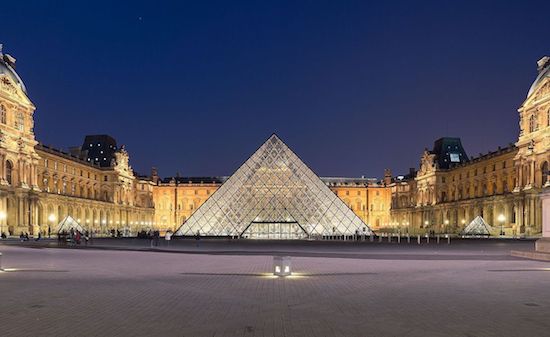

Genesis: The Benben stone was named after a primeval mound arising from the primordial waters of Nu in the creation myth of the Heliopolitan form of ancient Egyptian religion. Benben signifies the “Genesis” point of Creation.
Solar: The Benben stone was a sacred stone in the temple of Ra at Heliopolis. Ra is a sun-god and Heliopolis is the “City of the Sun”.
Stone from heaven: It’s often theorized that the Benben Stone was a meteorite.
So… you get the point. You get the message.
What it was, was a deep impact “ritual” by NASA simulating a Genesis event designed to imply in part the Sirius star system was somehow involved in the profound cosmic process constituting our “origin”.
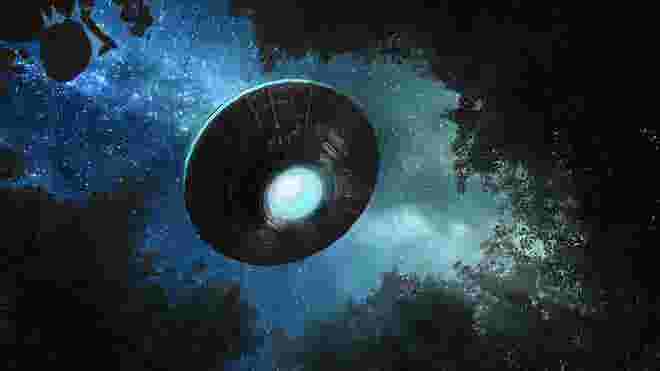
And yes, Genesis looked like a UFO crash, almost certainly by design.
+ – + – + – + – + – + – +
Genesis shook the earth on September 8, 2004, just a few months before the biggest “great flood” event in modern history – Sumatra (December 26, 2004).

Genesis was launched on August 8th, 2001, just a month before the biggest terror event in modern history – 9/11.

And now…?

The beginning and the end. Alpha and Omega.
To be continued…