
Timegate: Mars
Written by Goro, October 12, 2017
A New World shift from America to Mars
The following are long excerpts from Chapter 12 & 13 of my book The Time Rivers (2003) where I discuss the end of the American New World and the rise of the Martian New World in the 21st century. The Nile represents the primary “Time River” tracking the flow of history on this planet which is supplemented by a number of secondary Time Rivers around the world, most notably the Tigris-Euphrates in Mesopotamia and the Mississippi in the United States.


While the Nile’s timeline points to the latter part of the 21 century as the “end of history/time”, the Mississippi’s American timeline pinpoints the start of the 21st century as the end point (of the New World). From these it may be inferred that the 21st century is the “final phase” of the world as we know it and that this is to be marked by an epic “passing of the New World torch” from America to Mars.
Since this “New World transition” process has greatly intensified and came to the forefront in terms of multicontextual signaling in 2017, I felt this is an appropriate time to present the following and help flesh out the hidden context underlying what’s happening all around us now.
* * *
[Excerpts from The Time Rivers (2003) by Goro Adachi]
.
Chapter 12 The North-American Time River
Africa has the Nile. Mesopotamia has the Tigris-Euphrates. Naturally, we begin to wonder if there are other Time Rivers in different regions of the world – after all, the Nile and the Tigris-Euphrates are not the only rivers that have contributed to the development of human civilization.
Indeed, there is one particular river that catches our attention – the Mississippi River. Regarded as the chief river of North America, it runs vertically through the United States, almost exactly from the northern border to the southern edge. Clearly, it is the river of the United States.
And it will not disappoint us.
The Mississippi is about to be revealed as the ‘North-American Time River’ designed to track the history of the New World! And with the Mississippi, the encoded timeline will finally reach our own era and the leading country of our own time.
Somewhat troubling, however, is the embedded implication. As we’ll see, the United States is apparently designed as a ‘terminal station’ where time reaches an ‘edge’. Or to put it another way, according to the encoded timeline the United States is to be the final chapter of the ‘book of history’.
Deciphering this ‘final timeline’ will give us a refined sense of our place in the great scheme of things. And this upgraded perspective itself may well turn out to be the ticket that will allow us to enter the realm ‘beyond the edge’, the next phase of human civilization.
The Course of the New World
Ultimately, a person is only as good as his or her perspective. One’s awareness, ability to think, behavior, etc. – all interconnected – are regulated by the collective information stored or made accessible in the conscious/subconscious mind, which is analogous to ‘perspective’. And with it the brain formulates a model of ‘reality’ upon which, in turn, the person’s cognition, decisions, and actions – i.e. the ingredients of ‘personality’ – will be based. Therefore a massive change in people’s collective perspective prompted by the introduction of an extensive web of new information could signify the birth of a ‘New World’. This is something Europe experienced as recently as the Renaissance, the age of rebirth, during which, appropriately enough, a geographical ‘New World’ called America was also discovered.
On the verge of entering the next ‘New World’ waiting in the new millennium, mankind today has a lot to gain from reexamining the American ‘New World’. And we can do this effectively through the Mississippi River.

Figure 12.1 The Mississippi River flowing through the United States.
So, let us first address the question of why we should view the Mississippi as the North-American Time River.
This is actually quite simple. Besides being the chief/longest river of the continent, the Mississippi River (Misi sipi – ‘big river’) has the following attributes that are very suggestive of intelligent design:
- The river’s path is generally vertical (i.e. parallel to the meridian), flowing approximately from the northern edge to the southern edge of the United States
- The river system occupies the middle of the United States.
- New Orleans, the last notable point along the river’s course, is not only situated exactly on the key latitude of 30°N., it is also placed precisely on longitude 90°W.
- New Orleans is a French-flavored city and is often called the ‘Crescent City’. (The nickname supposedly comes from the fact that the city’s original section, the French Quarter, is situated along a big bend in the river.) It’s almost as if New Orleans is intended to be an American ‘Arc/Ark city’. (Although not discussed in this book, the Ark-Grail tradition has much to do with France.)
.
Further analysis will reveal a surprising degree of precision in the river’s layout and an encoded timeline that is directly relevant to the current generation of mankind. […]
American Timeline
What about a full-blown timeline for the Mississippi? Seeing the great length and complexity of the river system, I could not help but feel that it should be capable of yielding a complete timeline covering the entire American history.
To probe this possibility, I first had to come up with two dates that I could assign to two key points on the river. So I just asked myself: What are the two most momentous events in American history? The answer came rather easily: 1) Columbus’ so-called discovery of the New World in 1492, and 2) the United States’ birth in 1776.
Naturally, I inferred that the former should go to the Mississippi’s source. The latter, I reasoned, would have to go to the next most significant point. I quickly crossed out the river’s mouth since the nation’s beginning date would not logically mesh with the ending point of the river/timeline. So this left me with the ‘center’ of the river at Cairo, the major junction where the Mississippi is joined by the Ohio River.
When I saw the timeline produced by these anchor points, I was astounded. Simply put, it was everything an American timeline should look like!
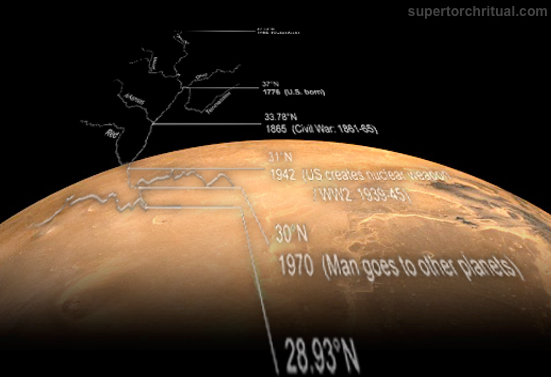
With uncanny precision, the Mississippi chronograph managed to pinpoint key events in US history:
- Anchor Point 1: AD 1492, the ‘discovery’ of America, is placed at the beginning of the Mississippi (47.24°N.).
- Anchor Point 2: AD 1776, the birth of the United States, is assigned to the Mississippi-Ohio confluence at 37°N.
- Using the resultant unit of ~27.73 yr./degree, the Mississippi-Arkansas confluence at 33.78°N. is converted into AD 1865. This precisely marks the time of the Civil War (1861-5) – the single biggest national crisis in US history! The very year 1865 actually saw the end of war which resulted in the unification of the south and north. The ‘unification of the Two Lands’ being a prominent Ark theme, we find it incredible that it is the ‘Ark. river’ (Arkansas River) pinpointing this American ‘unification of the Two Lands’.
- The next major confluence at 31°N., where the Red River joins the Mississippi, corresponds to the year 1942. This precisely pinpoints World War II (1939-45), the biggest war in history which the United States entered in 1941. The exact year 1942 saw the first artificially created nuclear chain reaction at the University of Chicago in the US, which along with the two US atomic bombs dropped in Japan (1945) ushered in the dreadful Nuclear Age.
- Next up is New Orleans at the key latitude 30°N., marking the year 1970. This coincides with one of mankind’s greatest achievements – visiting other celestial bodies for the first time in history! Most notably, Neil Armstrong – an American – took ‘one small step for man’ on the Moon in 1969, July 20. The following year (1970) saw the first spacecraft landing on Venus (Venera 7 of USSR), and 1971 saw the Soviets landing Mars 3 on the Red Planet. (The United States’ Viking I and II accompli-shed the first truly successful Mars landing in 1976.)
- The Mississippi’s southernmost point at 28.93°N. nicely marks the end of the second millennium (around 2000 AD) – that is, none other than our own time! The implication is that the beginning of the 21st century ‘ends’ the New World in some way.
.
(Another major confluence at 38.81°N. – where the Missouri River joins the Mississippi – corresponds to the year 1725, the significance of which is unclear.)
Figure 12.5 The American timeline decoded from the Mississippi River.
Notice how ‘exoteric’ all these pinpointed events are, in contrast to the shadowy nature of the events marked by the other Time Rivers. This certainly goes well with the positively public nature of the two events employed to anchor the timeline – Columbus’ ‘discovery’ of America and the birth of the United States.
And judging from this, we can expect an easily recognizable event to take place at the beginning of the third millennium that would in some way ‘end’ the United States, as suggested by the termination of the Mississippi River.
While not impossible, the prospect of the US terminating its existence simply did not seem realistic… until ‘9-11’.
9-11-01: Time Zero
When the phone rang early in the morning of September 11, 2001, I was fast asleep in my bed, probably dreaming about the day when my book is finally published – my main goal in life at the time. As I semi-consciously answered the phone in my best no-I-wasn’t-sleeping voice, I of course had no idea that one of the biggest events in modern history was taking place outside.
On the other side of the line, it turned out, was my brother who was already at work; and he wasted no time asking me if I was aware of the situation in New York and Washington DC. Although he sounded calm enough, I immediately detected a hint of nervousness in his voice and I knew that I was about to hear something shocking.
I jumped up from my bed as soon as he told me that two planes had crashed into the Word Trade Center twin towers and another one into the Pentagon. Fully awake now, I ran into the living room and turned on the TV.
By that time, all the major channels were covering the event non-stop with no commercials – which would continue for a week – and filling the screen were the surreal images of the violated twin towers spewing out black smokes into the stunningly clear blue sky. I sat and watched this scene in amazement. The entire nation was clearly in shock.
And then it happened.
As everyone watched in utter disbelief, one of the proud twin towers suddenly crumbled straight down to the ground, and the second tower soon followed. Both towers simply disappeared from the Manhattan skyline, and in their place was the monstrous, expanding wall of black smoke and ashes that almost seemed to engulf the entire city. The visual impact of the scene could only be compared to apocalyptic Hollywood movies.
This was such a devastating sight that even the usually mechanical news reporters appeared to have difficulty keeping their emotions in check. The feeling was universal – virtually every American was profoundly affected by the earthshaking development. And by noon, every-one knew that the world was no longer the same place. America, the ‘sleeping giant’, was rudely awakened.
It was only after the initial shock had subsided that I came to the disturbing realization – that this was potentially the fulfillment of the Mississippi-timeline ‘prophecy’. After all, it had predicted that a momentous ‘termination event’ would greet the US at the beginning of the 21st century.
Of course, as shocking as they were, the terrorist attacks did not ‘end’ the United States. Somewhat weakened and acting like a wounded animal perhaps, but the nation is still very much alive today as I write this.
How are we to interpret the situation then? Is there really a connection here?
To resolve this important issue, it is necessary for us to look into the deep symbolism of ‘9/11’. […]
Passing On the Torch
The 30th parallel is a ‘Martian latitude’: it is where we find Cairo, the ‘city of Mars’, and the Great Sphinx, the ‘Martian monument’, at Giza nearby. On the Mississippi timeline, it marks the time when five probes were sent to Mars, one of them (Mariner 9) becoming the first spacecraft to orbit the planet (1971).
This could also relate to the edge of the Mississippi since 30°N. represents the edge of the Nile. It certainly correlates well with the foregoing interpretation linking the Mississippi’s endpoint to Mars via the timing and symbolism of ‘9/11’. And even aside from that, the turn of the millennium has spawned a series of important discoveries concerning Mars, especially those involving evidence of water and ancient microbial life. As of 2003, in fact, the evidence has mounted to the point where it is generally considered a certainty that Mars currently has a lot of subsurface water.
And water, of course, is symbolic of time. Hence the discovery of Martian water would effectively signify mankind’s timeline moving on to the Red Planet.
Here, then, we have a quite reasonable solution to the issue of the American timeline terminating around the year 2000. If nothing else, it would be the end of America the ‘New World‘ – because that epithet is currently being passed on to the next new frontier, Mars. In other words, the United States doesn’t necessarily have to end its existence; instead it can just end its role as the ‘New World’ to comply with the Mississippi timeline.
From this perspective, we can view the first probes sent to Mars in the 1970s as the Martian version of ‘Columbus’, and the period between then and c. 2000 – i.e. the Mississippi’s final segment south of New Orleans – as the exploration phase reflecting the first 50-100 years of America after Columbus.
The next phase in the new century will naturally involve the colonization of Mars, which is likely to be initiated very soon, certainly before 2020. This will be ‘one giant leap’ for the evolution of human civilization; Mars is about to become the second home for mankind. And the momentous event appears to be occurring in precise accordance with the ‘timetable’ set by the Nile and the Mississippi.
It is also likely that humanity’s closer relationship with the Red Planet will involve the emergence of profound knowledge about our own past, giving us clearer insights into the significance of our own time and where we are collectively about to go.
Indeed, Mars’ revelations will be a key to unlocking the secrets of reality and our place in it. The next chapters will ‘preview’ some of these momentous revelations.
Chapter 13 Timegate: Mars
Columbus’ discovery of the New World was followed by a stream of European explorers and colonists quickly flooding the pristine land of opportunity. For better or worse, this ‘alien invasion’ of the new continent commenced a new chapter of human civilization – a chapter that is apparently coming to an end at the present time.
By the middle of the 1700s, the British pioneers had established 13 colonies along the eastern coast of North America, which would give birth to a great new nation in 1776, called the ‘United States of America’.
The driving force behind the new realm in the early days was the continuous migration westward to a new frontier. ‘The progressive humanist civilization that America generally represented resulted primarily from the great frontier of global settlement opened to Europe by the Age of Exploration’.
In accordance with this notion, when the line of settlement finally met the one coming from the west – effectively ending the American frontier – the United States faced by far the most serious national crisis, the Civil War, the division of the north and south. It was as if the whole nation was in pain from running out of space to explore and grow in.
While the United States did continue to evolve and has since become the leading superpower of the planet, there is a subtle sense creeping in today that the country has peaked and is now beginning to stall. It is as if the nation is running on empty but still managing to move forward only through the inertia generated by the past generations’ strong will. Even though Americans continue to follow the basic system molded by the pioneers, they no longer share the original spirit that was behind it. Unfortunately, without ‘spirit’ everything is prone to corruption.
The force of ‘spirit’ can generate a system but a system cannot give rise to a spiritual force. Inside the ‘ship’ of the United Sates, therefore, the engine has already gone quiet, and no new energy is being fed into the system. Consequently the ‘ship’ is slowing down and those inside have begun to adopt a conservative and defensive mindset. They are now going against the founding spirit of the New World. And along with it what makes mankind special – the ability to create and evolve – is disappearing.
Without a frontier from which to breath new life, the spirit that gave rise to the progressive humanistic culture that America has represented for the past two centuries is fading. The issue is not just one of national loss – human progress needs a vanguard, and no replacement is in sight.
The creation of a new frontier thus presents itself as America’s and humanity’s greatest social need. Nothing is more important: Apply what palliatives you will, without a frontier to grow in, not only American society, but the entire global civilization based upon values of humanism, science, and progress will ultimately die.
To escape corruption and revive our progressive human spirit, then, we ultimately need a new frontier. This is how we can free ourselves from the chains of the old system.
But where is the next new frontier?
Robert Zubrin, author of The Case for Mars (which details his well-received ‘Mars Direct’ proposal, a plan to quickly and cheaply send humans to Mars), boldly states:
I believe that humanity’s new frontier can only be on Mars.
Indeed, we are now routinely sending probes to Mars and all the indications are that we will see the first man on the Red Planet before 2020, if not 2015.
The timeline of human civilization is now going off planet and this is occurring in accordance with the schedule set by the Time Rivers. What we are witnessing in real time is the next ‘New World’ rising on the horizon.
Why Mars?
Besides Mars, mankind has the Moon and Venus within its reach at the present time. So why should Mars be singled out as the next ‘New World’?
The answer is quite simple: Mars is the only celestial body in our solar system that has all the material resources needed to support a full-blown, self-sufficient civilization. Mars also happens to be suitable for humans in terms of physiology: the duration of a Martian day (24 hours 37 minutes 22 seconds) closely matches that of Earth. And Mars even has Earth-like seasons thanks to its axial inclination of 24° closely matching Earth’s 23.5°.
Another crucial factor is the relative ease with which we can terraform the Red Planet – that is to say that we can change Mars’ global environment to be more like Earth’s. As fantastic as this may sound, it is actually just a matter of creating a ‘runaway greenhouse effect’ by simply raising the temperature by few degrees at the Martian polar region, which will then result in the evaporation of the entire icy polar cap, and:
As the cap evaporates, global atmospheric temperature and pressure will rise, and that, in turn, will initiate the liberation of huge quantities of carbon dioxide locked in the regolith. In short, a modest 4°C rise in temperature at the south pole can globally raise temperature by tens of degrees and transform a 6 millibar atmosphere into one measured in hundreds of millibars.
According to Zubrin: the heating of the polar region can be accomplished by, for example, placing a mirror in space to reflect sunlight and focusing it on the polar region; when the planet’s temperature has risen above the freezing point, Mars’ frozen water will begin to melt and flow into dry riverbeds; and the 120 millibars of oxygen required for humans and animals can be produced in 900 years or less.
But we don’t have to wait for Mars to be terraformed to begin colonization. Although there will certainly be various limitations, humans are very much capable of establishing Martian colonies today. The only question is: When do we feel like doing it?
Once we are on the Red Planet, Zubrin estimates that the population growth will be one fifth that of colonial America. If the process is to begin in 2010, the projection shows there would be about 10,000 people on Mars by 2050.
The comparison Zubrin makes between Mars and America is no coincidence; it is an underlying theme of his book. He even proclaims: ‘For our generation and many that will follow, Mars is the New World’. Arthur C. Clarke, widely respected for his visionary as well as realistic insights, has echoed the view in commenting that ‘Mars is where the action will be in the [21st] century’.
Interestingly, ‘life on Mars’ suddenly became a mainstream issue just as the world was approaching the new millennium. Right on schedule.
A case in point: on August 7, 1996, NASA held a press conference and introduced a meteorite from the Red Planet labeled ALH84001 which, the NASA scientists triumphantly claimed, contained ‘microscopic fossils of bacteria-like organisms’ from 3.6 billion years ago. President Bill Clinton described it as ‘one of the most stunning insights into our universe that science has ever uncovered’, if the findings were valid.
Rather conveniently, the momentous announcement was closely followed by NASA launching two probes to Mars – Mars Global Surveyor in November and Mars Pathfinder in December. Pathfinder then went on to generate quite an excitement as it successfully landed on Mars on July 4, 1997 – the first Mars landing since the Viking mission (1976). It was followed by Mars Global Surveyor successfully entering Mars orbit in September.
After these came a string of more Mars missions. This is still continuing today and will likely go on until man takes ‘one small step’ on the Red Planet.
The timing of this development seems suspiciously unnatural. It is as if the last years of the second millennium were ‘engineered’ to bring Mars into the spotlight, into the collective consciousness of the general public. Given what we now know, it is not too farfetched to speculate that someone was orchestrating these events from behind the scenes in order to follow the ‘script of history’. […]
Life After Resurrection
What about future interaction between Mars and Earth? Considering that history is essentially a cycle of patterns, one way to project future events is to identify a ‘resonant’ period in the past. And thanks to the strong parallel found between Mars and America, we are in a fortunate position of being able to forecast the basic event pattern that the next New World may follow – by simply transposing American history to fit the Martian context.
The first step, then, would be to discern the basic progression of American history, which may be summarized as follows:
1. Discovery
2. Colonization & expansion
3. Two countries’ struggle for control
4. Achieving independence
5. Overpowering the original inhabitants
6. Issue of slavery
7. Civil War
8. Leading power of the world
By transposing these to fit the new context, we will hopefully have a rough outline of the future ordeals awaiting us in the next New World.
In view of the fact that our space program has already ‘discovered’ (i.e. landed on) Mars, we should be at the first phase of Step 2 right now.
We’ll be in Step 2 more fully when we see the first manned mission to Mars, which should take place soon. After that, the population of the new ‘New World’ should grow rapidly just as it did in America.
According to the American progression, Mars is then to have two powers competing for the control of the land, just as Britain and France did for North America during the colonial period. While it is not hard to imagine that one of them will be the United States (or perhaps not), identifying the other contender is difficult at this time (it will perhaps be Russia, united Europe, or China). Whatever the case, it is fascinating to ponder how the struggle over Mars may turn into the first case of ‘Star Wars’ in known history.
We are also likely to see a ‘Star Wars’ action in the next step – the struggle for the independence of the Martian colonies (Step 4). This battle the colonial forces would win, resulting in the birth of the first independent state in space. And the loser of this struggle may well turn out to be the United States, just as it was the parent country, Britain, that the American colonists had to overcome.
Transposing Step 5, ‘overpowering the indigenous people’, to fit the Martian context is trickier because it’s unlikely we’ll find any indigenous Martian humanoids living on the Red Planet – at least not currently. If we consider the original environment as the ‘original inhabitants’, however, terraforming of Mars will nicely fulfill Step 5.
Step 6, the disagreement over the issue of slavery that would lead to Step 7 (Civil War), is also problematic. Slavery as we know it today is so barbaric a practice that the likelihood of it being part of the advanced Mars civilization is extremely remote, especially after the hard lessons learned in the former New World.
But there can be a transposed form of the slaves. A good candidate for the role, I would say, is artificial intelligence or genetically engineered/modified/cloned humans (or humanoids) – or a mixture of the two. As computers, genetics, robotics, bionics, and such will have evolved much further by the time of Step 6/7, it seems inevitable that mankind will have given birth to a new ‘race’ designed to serve humans – i.e. ‘slaves’. Then, it could be imagined that the basic rights of the created intelligence would become a major issue at some point, especially on Mars where such an artificial labor force would be most needed and utilized.
If the progression of the former New World is to be followed, a ‘civil war’ will break out over the high-tech ‘slavery’ issue, which the faction favoring the rights of the ‘new race’ would win.
After all those ordeals, the Martian civilization would go on to surpass the Earth civilization and become the leading faction of mankind (Step 8), just as the U.S. did after the Civil War.
And this completes the basic 8-step progression of the New World. There is, however, an esoteric or hidden side of America that would add some extra steps to the progression.
While I decided not to discuss it in this book, we find that the discovery of America and the formation/evolution of the United States were both something actively facilitated by certain ‘underground’ esoteric organizations such as Freemasonry. (The tradition of Freemasonry can be traced back to the mysterious medieval order of the Knights Templar, which in turn was intimately associated with the Ark-Grail tradition.)
Without going into details, evidence suggests that these select people were visiting the New World long before the rest of the European populace became aware of the land’s existence. And based on this, the possibility must be considered that we are to have some secret manned voyages to the Red Planet before the public arrival of the new ‘Columbus’.
And this may have already taken place!
It is therefore possible that the hidden seeds of the future are already there quietly setting the stage – so that the next chapter of human civilization will unfold according to a ‘script’.
Admittedly, the above discussion is highly speculative. But can we go one step further and figure out the timetable that is to be followed by the pertinent future events?
While it seems probable that the general timeframe would be the next 200 years or so, the Time River system does not seem to give us any specific chronological data on this matter. It is possible, however, that the ancient riverbeds of Mars bear such information. Or perhaps humans reaching the currently river-less Red Planet should be interpreted as humans finally overcoming the chains of destiny and time, which will give rise to a new age in which man’s own will is to be solely responsible for his/her own future.
Personally, I cannot help but hope that it is indeed ultimately the human spirit that will be ‘resurrected’ from the ‘tomb of time’ in the coming New World. Because if so, the gateway we are currently going through is the gateway to infinite possibilities where we finally become what we really want to be, and who we really are in essence.
* * *
[End of excerpts from The Time Rivers]


